

By Sean Peterson, Student Intern
I’ve been playing basketball for 14 years now and am currently going into my senior year of college. Basketball has been an essential part of my life and has helped me gain and sustain confidence, build a social circle, and get a great source of exercise for years. I’ve sprained both of my ankles numerous times during my years of playing. These injuries often happened during the season, so I would seek treatment from the athletic trainer. However, as soon as I felt my ankle was ready, I would tape it and get back on the court.
Repeat ankle sprains continuously injure the ligaments of the ankle that provide stability. After injury, ligaments get stretched, which can cause laxity that becomes chronic. Think of the opposite of a rubber band. When ligaments are overstretched, they remain in that stretched position and don’t retract back to normal. This often results in chronic, repeat ankle sprains.
Through my journey as a pre-physical therapy student, I’ve learned to change the way I approach these injuries, which has helped me understand what it takes to return to the game I love.
Background on Ankle Sprains
An ankle sprain occurs when one or more of the ligaments that connect the bones that make up the ankle are either stretched beyond their usual limits or partially torn. Ligaments connect bone to bone and help to keep the ankle stable during movement. The sport of basketball places a lot of stress on the ankle ligaments because it requires frequent jumping, landing, sprinting, stopping, and changing direction in unpredictable scenarios.
There are three types of ankle sprains. The most frequent type of ankle sprain in basketball is the lateral sprain. A lateral sprain happens when the foot rolls inward (inversion)and the ligaments on the outside of the ankle are stretched or torn. The most common ligament affected is the anterior talofibular ligament (ATFL), and in more severe cases the calcaneofibular ligament (CFL).

The medial ankle sprain is a lot less common due to the fact that the deltoid ligament on the inside of the ankle is much thicker and stronger than the ligaments on the outside of the ankle. The lateral malleolus also helps prevent this. The medial ankle sprain occurs when the foot tilts outward while the ankle rolls inward into eversion, and a much higher amount of force is required. In some cases, fractures or other injuries occur along with a medial sprain due to the sheer amount of force that’s needed to damage the deltoid ligament.
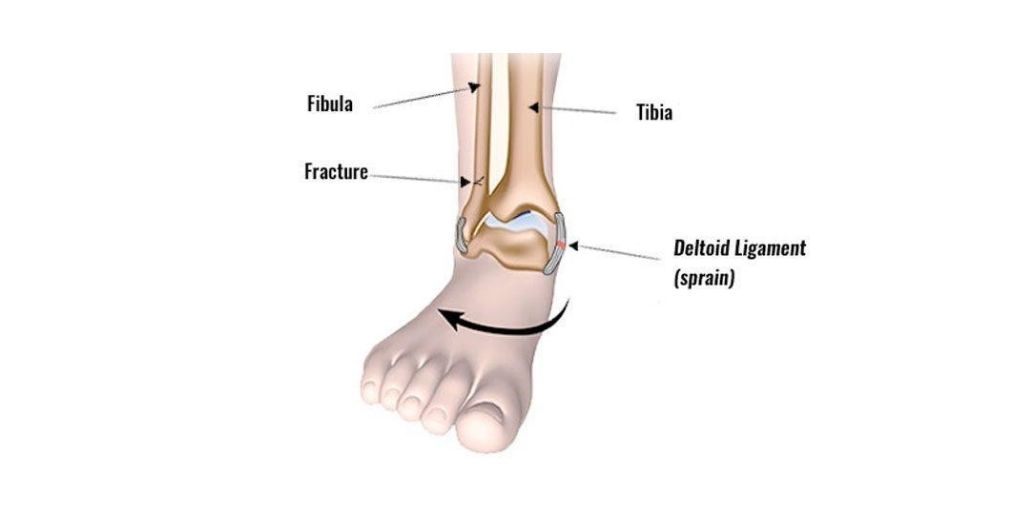
The last type is a high ankle sprain, which can also be called a syndesmotic sprain. This type of ankle sprain doesn’t involve the ligaments on the sides of the ankle, but instead the ligaments that connect the tibia and fibula to the ankle joint. High ankle sprains usually happen when the foot is planted while the leg twists outward.

Ankle sprains are also classified based on severity. A Grade 1 sprain occurs when there is mild stretching of the affected ligament, as well as minimal swelling and 10%-20% loss of function. A Grade 2 sprain involves a partial tear of the ligament. This will result in a greater amount of pain, swelling, bruising, and some instability as well. Finally, a Grade 3 sprain is a complete tear in the ligament, which will cause significant swelling, bruising, instability, and difficulty bearing weight.
These grades are helpful to provide a general idea of the severity of the sprain, but they shouldn’t be determined solely based on the pain or swelling in the ankle. They’re a guideline for understanding severity; however, pain and swelling shouldn’t be used alone to determine tissue damage. We recommend a full assessment by a medical provider to determine severity.
Why Ankle Sprains Keep Coming Back
A strong predictor of future ankle sprains is having a previous ankle sprain. Every time I returned to basketball without fully restoring my ankle function and strength, I increased my risk of another injury.
After an ankle sprain happens, the muscles surrounding the ankle joint become weaker and proprioception decreases. Proprioception is the body’s ability to sense the position of the joint. This means that when the ankle starts to roll, it can’t react as quickly to try to correct itself. If these systems aren’t restored during the rehabilitation process, then the ankle can still be vulnerable to future sprains even once the pain or other symptoms are resolved.
Fatigue can enhance this problem even more. As a player tires, the muscles around joints, such as the ankle, knee, and hip, become less able to control movement. This in turn slows down reaction time, makes landing mechanics less efficient, and makes it more difficult for the body to maintain proper alignment during cutting and jumping activities in basketball or any sport. Weak calves, hips, core muscles, and glutes can also lead to increased stress on the ankle.
Limitations in ankle mobility can also lead to inhibited ankle strength, which can cause additional issues in the future. If the ankle is unable to reach its full range of motion, then the body may compensate with an alternate gait pattern. Compensation can happen by changing movement patterns through the knee or hip, which increases the risk of ankle sprains recurring, as well as increasing the possibility of other lower-extremity injuries.
Safely Returning to Basketball
For the longest time, I believed that as long as I was able to walk without pain and had minimal pain while I played, I could return to basketball and play at the highest level. However, this is not the case because basketball, and most sports, are more demanding than walking or even jogging, due to quick, explosive movements, like sprinting, stopping, pivoting, jumping, landing, and reacting suddenly. To perform these movements, one needs the strength, balance, coordination, and confidence in the injured leg to do so safely.
Resting an ankle sprain is only part of the rehab process. Rest without rehab may cause the athlete to lose muscle strength, joint mobility, and balance. This means that once the ankle feels better, it’s not the best decision to return to full speed right away, as it may not be prepared for the physical demands of the sport.
Prior to returning to any sport, the athlete should be able to comfortably jog, sprint, jump, cut, and perform a hopping motion on a single leg without the feeling of pain or instability, while also maintaining confidence. Being able to walk or jog without pain is an important milestone; however, it’s not sufficient for an athlete to go back to playing basketball at full intensity.
Rehabilitation from an ankle sprain should have a main focus on restoring strength, balance, mobility, full range of motion, and confidence. By strengthening the calves, feet, hips, glutes, and core, overall lower-body stability can be achieved. Single-leg exercises and balance exercises will help restore proprioception, which will reduce the risk of another sprain. Rehabilitating an ankle sprain should also involve some sort of lateral movement, jumping and landing mechanics, and agility drills. These movements closely mimic the movements that are needed for basketball.
The chance of injury also increases if there is not a proper warmup before basketball. A proper warmup includes:
- Dynamic stretching
- Light jogging
- Bodyweight exercises
- Movement drills to increase heart rate and activate muscles
Proper equipment can also be a useful strategy for preventing injuries such as ankle sprains. Making sure shoes fit appropriately and have good traction, as well as the using ankle braces, can provide additional support, but these tactics shouldn’t be solely relied upon or replace rehabilitation or strengthening.
If I understood then what I do now when I had my first few ankle sprains, I would have taken more initiative and precautions. I thought of each injury as its own event instead of addressing the underlying weakness and instability of my ankles. Through studying to be a physical therapist, I have learned that rehabilitating an ankle sprain is about more than just reducing pain and swelling. It’s about restoring function, flexibility, range of motion, and strength, and preparing the ankle for the unpredictable demands of the sport.
The advice I’d give my younger self, or anyone returning to basketball from an ankle sprain, would be to respect the rehab process and strengthen the entire lower body instead of rushing back to play. This isn’t a process done alone, nor should anyone expect to know how to do this alone.
If you’d like help returning to basketball, or any sport, from an ankle injury, contact us to schedule an appointment.